
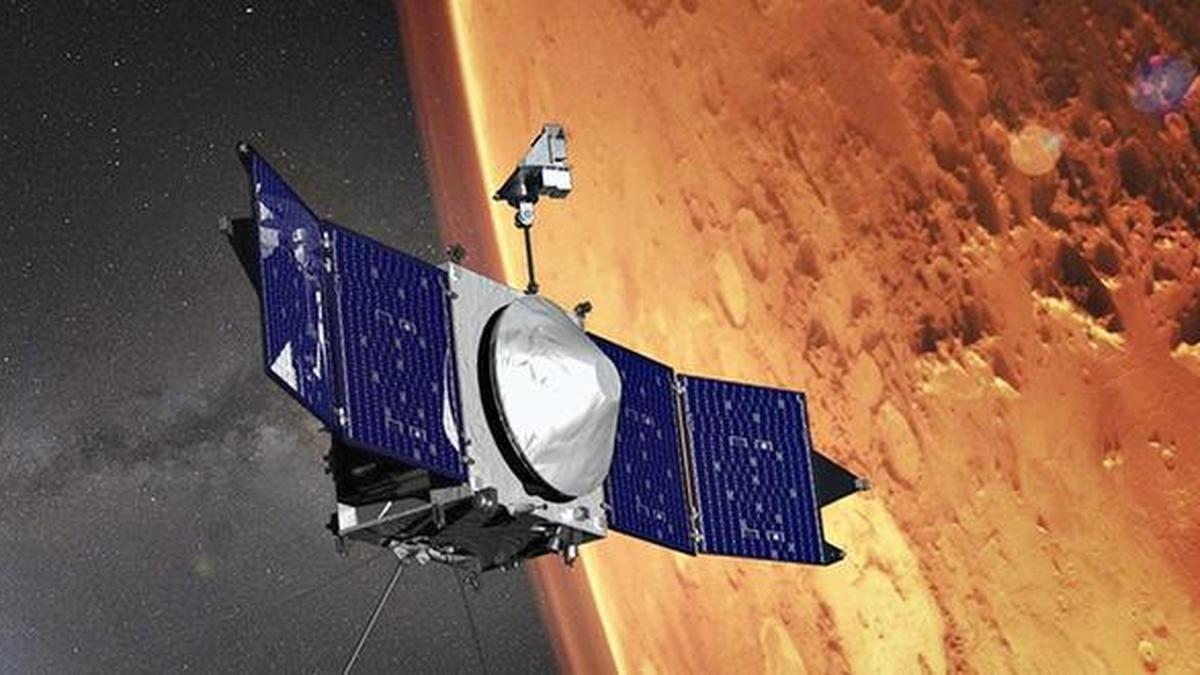
According to a new research report, evidence of Zwan-Wolf effect has been found on Mars. France, UK, and US An international team of scientists from across the United States has studied this effect through NASA’s MAVEN mission. This study has been published in the prestigious scientific journal “Nature Communications”, which helps in understanding new aspects of the Martian atmosphere and plasma squeezing.
The Zwann-Wolf effect, considered important in plasma physics, reflects the complex interactions between electric charges and magnetic fields. Detecting this effect on Mars can help us understand how the atmosphere of Mars is changing over time. The MAVEN spacecraft collected detailed data of the upper layers of the Martian atmosphere, which proved the existence of this effect. According to this study, the Zwan-Wolf effect is related to the transmission of small particles and their magnetic field, which affects the atmosphere of Mars. It also provides updated information about the process of atmospheric loss on Mars. Scientists believe that this effect could be a reason for the gradual melting of the atmosphere on Mars and being blown into space.
Lead researcher Dr. Anne Traversau said, “Data from the MAVEN mission has given us the opportunity to make deep observations of plasma dynamics. Confirmation of the Zwann-Wolf effect will help us understand the micro-dynamics of the Mars atmosphere.” This discovery will enable better preparation of the atmosphere for future human missions to Mars.
This research will be helpful in understanding the atmospheric processes not only of Mars but also of other planets of the solar system. This new discovery is being considered important in the scientific community, which can open a new direction in the field of planetary science.